
CHAPTER 7: MINDS, MORALS, AND IDENTITIES:
PSYCHOLOGICAL INSIGHTS INTO LGBTQIA+ INCLUSION

“Thou shalt love thy neighbour as thyself.”
–Jesus (Mark 12:31)
I define moral systems as interlocking sets of values, virtues, norms, practices, identities, institutions, technologies and evolved psychological mechanisms that work together to suppress self-interest and make cooperative societies possible. This definition allows conservative and religious communities to qualify as moral communities.
-Jonathan Haidt (Weir, 2012)
Psychology offers a powerful lens for understanding how individuals form identities, navigate moral landscapes, and respond to social norms—especially when those norms conflict with personal experience. This chapter explores how psychological science contributes to our understanding of LGBTQIA+ identities, particularly in relation to those Christian moral frameworks that often reject or marginalize queer individuals.
Drawing on empirical research and theoretical models, the chapter introduces the SCOPES framework—a holistic approach to identity that integrates cognition, behavior, emotion, physiology, and social context (Sutton, 2016). It also examines the concept of gender dysphoria, highlighting the psychological and social factors that shape distress and resilience among gender-diverse individuals.
In the second half, the chapter turns to Moral Foundations Theory (MFT), a model that explains how different groups prioritize values such as care, fairness, loyalty, authority, purity, and liberty (Haidt, 2012). By comparing conservative, progressive, and secular moral profiles, the chapter reveals how divergent ethical emphases influence attitudes toward LGBTQIA+ rights, relationships, and bodily autonomy.
Together, these psychological perspectives offer a nuanced understanding of the tensions between religious doctrine and human diversity—inviting readers to consider how science, ethics, and faith intersect in shaping both personal identity and public discourse.
AN OVERVIEW
Psychology is the scientific study of the mind and behavior, encompassing both theoretical inquiry and practical application. It seeks to understand the intricate processes underlying cognition, emotion, and action, the biological substrates that support them all within social contexts. As a behavioral science, psychology employs empirical methodologies to investigate how individuals and groups think, feel, and act across diverse contexts (American Psychological Association [APA], 2018; British Psychological Society [BPS], n.d.).
At its core, psychology bridges the subjective experience of the mind with the objective mechanisms of the brain. This dual emphasis allows researchers to explore phenomena ranging from neural circuitry and hormonal regulation to memory, decision-making, and social interaction (e.g., Hebb, 1974).
Applied psychology refers to the practical implementation of psychological principles to solve real-world problems. This includes domains such as clinical psychology, school psychology, industrial-organizational psychology, and health psychology, where psychological science informs interventions, assessments, and policy (BPS, n.d.; Matarazzo, 1987). Through its applied branches, psychology contributes to mental health care, workplace efficiency, educational reform, and public policy, demonstrating its relevance beyond academic inquiry.
In this chapter and the next, I present psychological research relevant to understanding the gap between Christian and scientific perspectives on LGBTQIA+ individuals.
ORGANIZING PERSPECTIVES
Following from the foregoing definition of psychology, I apply a basic functional extension of six domains of human functioning commonly assessed in a psychological evaluation using the acronym SCOPES.
People have a sense of Self (S), which is heavily influenced by information from the four core biopsychological domains represented by the letters COPE (Cognition, Observable Behavior, Physical, Emotional). The Self and a person’s psychological core (COPE) are in a dynamic relationship with a person’s Social contexts (Second S in SCOPES), which for most people change throughout a day and certainly over a person’s lifespan (Sutton, 2016a).
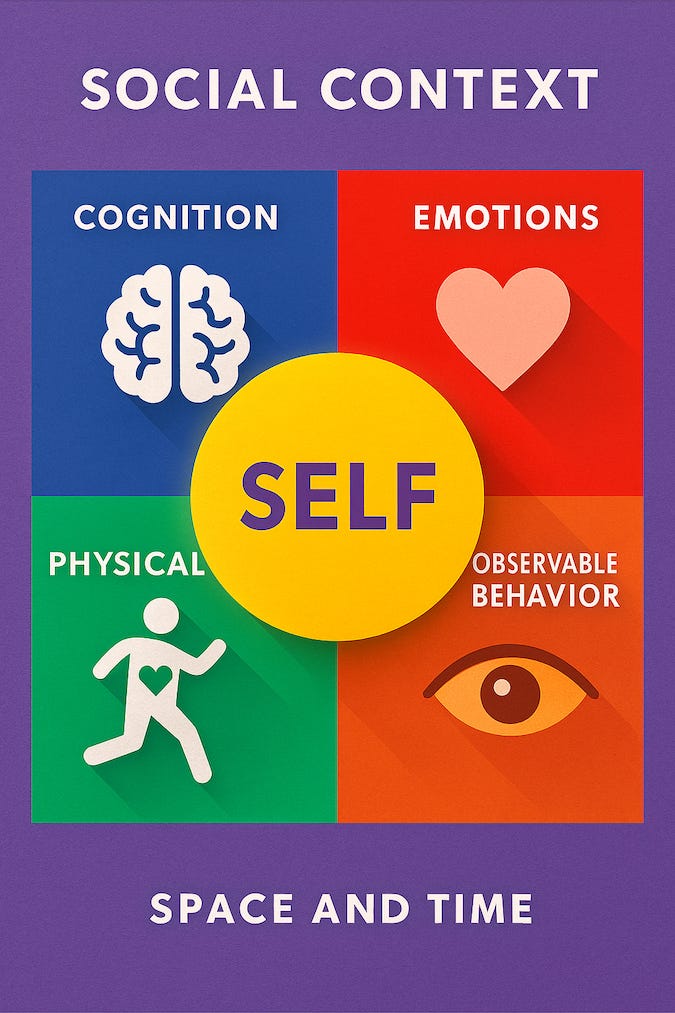
SELF
In psychological literature, the term self refers to the organized, dynamic system of beliefs, emotions, and cognitive representations that individuals hold about themselves, encompassing multiple dimensions including self-identity, self-concept, self-esteem, and self-efficacy.
Self-identity denotes the sense of continuity and uniqueness that individuals experience across time and contexts, often shaped by social roles, cultural affiliations, and personal narratives. Self-identity is the most relevant aspect of self to the study of the identities in conflict between Christian theologies that reject identities of people in the queer community and affirmed by mainstream psychological organizations. The most obvious example of the conflict is the expression “gay Christian is an oxymoron” (Hendrix, 2025, June 8). Being a Christian is one of the salient identities common to billions of people.
At least the following self-identities are relevant to this book. A self-concept may include several identities, variations on self-esteem, and self-efficacy.
I am a Christian (which may be further detailed)
I am a gay Christian
I am gay affirming
I am a psychologist, psychotherapist, counselor, social worker…
I am a mother. I am a father.
I am a woman or girl. I am a daughter.
I am a man or boy. I am a son.
I am female.
I am male.
I am queer and Christian.
I am gay, lesbian, bi, trans, intersex, queer, gender nonconforming, asexual, aromantic, and so forth.
Alternative self-identities for Christians who do not fully embrace an LGBTQIA+ identity may include:
I am celibate
I am a Christian who is attracted to members of my own sex
Some queer Christians use affirmations like the following:
I am created in God’s image.
I am a gift to the church.
I am a witness to grace.
People also define their identities negatively to clarify that they are not “one of those…”
I am not an abomination.
I am not broken.
I am not your project.
I am not ashamed.
People have many identities beyond their faith, relationship status, vocation, sex, and sexual orientation. For example, nationality, race, ethnicity, and political party affiliation are important identities to many. People with minority identities experience life differently than those who match the identities of people in power positions.
Thoughts, feelings, behavior patterns, physical characteristics, and social context inform self-identity thus, Self is a product of COPE +S (cognition, observable behavior patterns, physical/health, emotions plus social contexts). The self is a dynamic construct. Our understanding of ourselves changes as we experience life.
Gender Dysphoria
When identities appear incongruent people may experience significant distress, which may be diagnosed as gender dysphoria. Cognitions can involve questioning one’s gender, dislike for one’s anatomy, and suicidal thoughts. Common emotional experiences include anxiety and depression (Marconi et al., 2023).
Behavior patterns may include gender-affirming actions such as clothing choices, voice modulation, or social role changes to align with their experienced gender. Self-harming behavior may also be present. These behaviors are often adaptive attempts to reduce dysphoria but may also provoke social stigma or familial conflict (Dutton & Madison, 2021). Emerging research suggests that gender dysphoria may be linked to neurobiological and hormonal factors.
Finally, gender dysphoria is shaped by cultural norms, legal frameworks, and interpersonal relationships. Discrimination, lack of access to gender-affirming care, and societal invalidation contribute significantly to the distress experienced by individuals with gender dysphoria (Marconi et al., 2023). The social environment can either mitigate or exacerbate the psychological burden depending on its level of acceptance and support.
COPE: THE CORE FOUR DOMAINS
COGNITION (C)
Cognition involves thoughts, memories, images, and abilities. Depending on their parents, health care providers, and faith community, sexual minorities will have a varied store of memories reflecting the way they have been treated and repeated words others have used about them. Some may be affirming but so many of their thoughts and images reflect words of harassment and abuse as well as images of rejection and possibly even violence. The ability to cope with destructive thoughts and images varies widely and is important to wellbeing.
OBSERVABLE BEHAVIOR (O)
Observable behavior refers to those durable patterns of behavior that form unique personalities. Psychologists commonly recognize five or six meta-personality traits or behavior patterns of openness, conscientiousness, extraversion, agreeableness, and neuroticism in addition to other traits like humility and dominance. It is only in recent years that some LGBTQIA+ individuals have acted on their desires for intimacy by openly showing affection to a same-sex spouse or friend. Others have expressed their inner thoughts and feelings about their treatment by participating in protest rallies or pride events. Some may engage in self-harming behavior. We should also be aware that many same sex attracted individuals have attempted to try or fake going straight including attempting a heterosexual marriage despite struggling with thoughts and feelings about the unnaturalness of such relationships.
PHYSICAL (P)
The physical domain encompasses our biological functioning, which includes our general health, hormones, and anything we take to alter or sustain our biological functioning such as medicine, food, and drink. In this category, we consider the influence of hormones, chromosomes, surgeries and other interventions on one’s overall functioning and the effect on the core self. We should also be aware that access to medical care varies widely and may even change during the course of a person’s treatment.
EMOTIONS (E)
Emotions are sometimes difficult to describe, but many recognize feelings as positive and negative. Emotions are part of what it takes to motivate people to act. We may see happy and well-adjusted sexual minorities in loving relationships. Sadly, we know many struggle with feelings of guilt, disabling depression and anxiety. We can expect many to feel anger and resentment toward those who have insulted and abused them. Those struggling with gender identity may experience intense distress, which is a characteristic of gender dysphoria.
SOCIAL CONTEXTS
Social contexts refer to the influences of our location, the people present, and the time of day or year. Context is a matter of space and time. Clearly influential people in the lives of sexual minorities affect their self-identity, the contents of their memories, how they feel, and their health. Religious leaders and lawmakers decide what books they can read in school, what behaviors they can demonstrate in public, what healthcare is available, where they can or not live and work, and what legal relationships they may enjoy. Religious leaders also decide on what sacred places they may visit and how they must behave within those sacred places. In addition, religious leaders may influence congregants on how to treat people who identify as LGBTQIA+ and how to vote. They may also persuade lawmakers to enact legislation governing the behavior of sexual minorities.
In summary, individuals may have multiple identities and experiences. People whose sex or gender identity differs from the majority may encounter various challenges depending on their thoughts, feelings, behavior, and physical condition (COPE). A comprehensive perspective on brain-behavior relationships within social environments is important for understanding human well-being and supporting those who experience distress. The SCOPES model provides a model to encourage holistic thinking rather than focusing on one or two aspects of personhood.
MORAL PSYCHOLOGY
Researchers developed moral foundations theory (Graham, Haidt, & Nosek, 2009; Haidt, 2001, 2012; Haidt & Graham, 2007; Haidt & Joseph, 2004) by identifying sources of virtue observed across various cultures. This section briefly describes the theory and applies the concepts to understanding moral perspectives on human sexuality and gender diversity.
SIX COMPONENTS OF MORAL FOUNDATIONS THEORY
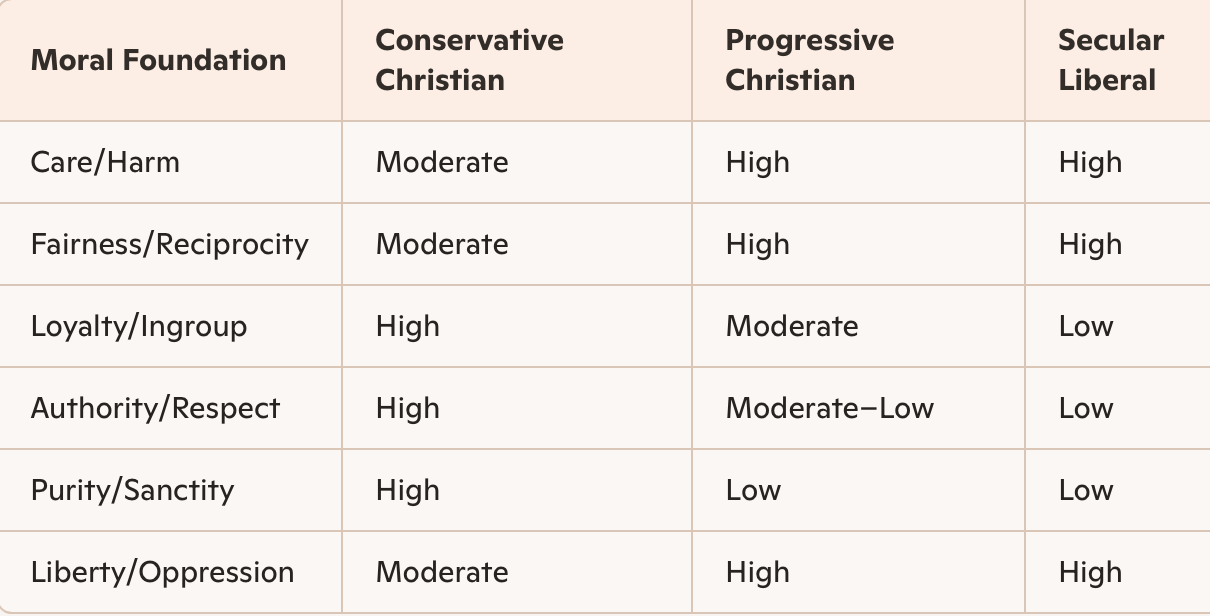
Moral Foundations Theory (MFT) identifies six core dimensions that underlie moral judgments and may be applied to sexuality (Sutton, 2016a). Two individualizing foundations emphasize the rights and welfare of individuals. The care/harm foundation motivates protection against suffering, while the fairness/reciprocity foundation concerns justice, rights, and equitable exchange (Sutton, 2016a).
Three binding foundations promote group cohesion. The loyalty/ingroup foundation values solidarity and allegiance; the authority/respect foundation upholds hierarchical order and deference to legitimate leadership; and the purity/sanctity foundation reflects an aversion to physical or spiritual contamination (Sutton, 2016a).
A sixth foundation, liberty/oppression, captures the preference for autonomy and resistance to domination, driving opposition to coercive authority and support for free choice (Sutton et al., 2019).
MFT, CHRISTIANS, AND LGBTQIA+
This section contains a brief overview of an MFT study (Sutton et al., 2019), which illustrates group differences on the six moral foundations.
Conservative Christian Perspectives. Among conservative Christians, binding foundations carry greater moral weight than individualizing ones. Sutton et al., 2019) found that high endorsements of loyalty, authority, and purity correlated with stronger objections to same-sex relationships, framing LGBTQIA+ identities as violations of divinely ordained social order and bodily sanctity.
Progressive Christian Perspectives. Progressive Christian thinkers reorient moral emphasis toward care and fairness (Sutton, 2016b). In their view, scriptural mandates to alleviate suffering and pursue justice override traditional purity-based prohibitions. Authority and loyalty concerns recede, enabling affirmation of LGBTQIA+ rights within a broadly Christian moral framework.
Secular Liberal Perspectives Secular liberals likewise elevate individualizing and liberty foundations. LGBTQIA+ rights are defended as matters of harm prevention, equal treatment under the law, and individual autonomy. Binding foundations—authority, loyalty, and purity—hold minimal sway, and religious injunctions against LGBTQIA+ identities are largely dismissed as irrelevant to civic morality (Sutton, 2016b).
Refer to Table 7-1 for a concise overview of Christian and secular perspectives on morality. It is important to recognize that the classifications of low, moderate, and high are specific to the context of this research sample and should not be extrapolated to all individuals affiliated with either conservative or progressive branches of Christianity, or those identified within the secular-liberal category.
Table 7 – 1
Relative Emphasis of Moral Foundations Across Perspectives
MFT: A MORAL PSYCHOLOGY LENS
ON CHRISTIANS ATTITUDES TOWARD LGBTQIA+ PERSONS
In this section, I review the six moral foundations of MFT and suggest different ways conservative and progressive Christians might express their perspective.
CARE / HARM
Both conservative and progressive Christians frequently invoke the concept of harm when evaluating the morality of specific actions. In many ethical frameworks, the opposite of harm is care. Within Christian theology, this contrast is exemplified by Jesus’ articulation of the second greatest commandment: “Love thy neighbour as thyself” (Mark 12:31). The parable of the Good Samaritan further illustrates this ethic of care, portraying a man who tends to a beaten stranger in contrast to others who leave him untreated by the roadside (Luke 10:25–37).
Conservative Perspectives on Harm. Conservative Christians often interpret same-sex marriage as harmful to both individuals and the church. Drawing on biblical texts, they argue that same-sex relations constitute acts of immorality, which may result in divine or natural consequences. Historically, this view contributed to the belief among some Christians that the AIDS epidemic represented divine punishment, particularly because the disease initially appeared prevalent among gay men. However, this interpretation has waned as AIDS has affected broader populations, including heterosexual adults and children.
A more nuanced conservative stance emphasizes spiritual harm. From this perspective, individuals who violate biblical teachings may face consequences determined by God, rather than immediate physical or social repercussions. Another concern among conservatives is the perceived harm to the institution of marriage. Citing scriptural passages, they uphold a Christian model of marriage as a covenant between one man and one woman. Departures from this model are viewed as disruptive to both the Christian community and societal order.
Additionally, many conservative Christians oppose surgical interventions that alter an individual’s birth-assigned sex, viewing such procedures as violations of God’s intentional design.
Progressive Perspectives on Harm. Progressive Christians prioritize the harm experienced by individuals who are attracted to members of the same sex. Denying LGBTQIA+ persons the right to marry and form intimate relationships is seen as inflicting lifelong emotional distress. Further harm arises when conservative institutions restrict access to education (e.g., Christian colleges), employment, housing, and worship. These limitations can lead to economic hardship, social isolation, and spiritual alienation.
Some progressive theologians reinterpret biblical condemnations of same-sex relations, suggesting that Paul’s critiques were directed at exploitative or abusive practices—such as the sexual abuse of children and vulnerable adults—rather than consensual, loving relationships between adults. In matters of gender-affirming medical care, progressive Christians advocate for individual autonomy, trusting patients to make informed decisions in consultation with healthcare professionals. They may cite examples of children born with congenital conditions that require surgical intervention to improve function, correct defects, or enhance survival, framing such procedures as consistent with compassionate care.
FAIRNESS
In both social and moral contexts, fairness is commonly understood as the obligation to treat all individuals as equals. Most people consider it immoral to privilege some individuals over others in their ability to live freely and enjoy life. Laws and policies that permit or promote unequal treatment based on gender, race, ethnicity, wealth, or other identity markers are widely viewed as unjust. Within democratic societies, citizenship typically confers rights such as voting, legal protections, and access to social benefits. A foundational principle is that all citizens should be treated fairly—that is, with equal access to the privileges and protections afforded to others. Same-sex marriage remains a focal point in this discourse, as many same-sex couples are denied government and employer benefits unless legally married.
Conservative Christian views on fairness and equality. They do not support fairness or equality if it means violating ethical positions. The policies of Christian schools, organizations, and churches result in unfair treatment when fairness is defined as equal treatment. Put another way, LGBTQIA+ persons in romantic same-sex relationships or marriages cannot be students at Christian schools or employed at conservative Christian organizations. If they are students or employees, they need to remain celibate (Stern, 2014, July 16). In addition, Christian leaders have been advocates of laws that prohibit same-sex marriage and gender affirming care for transgender individuals. Moreover, Christians have worked to ban information regarding LGBTQIA+ individuals in certain segments of society. Various stories also appear in the news of Christians refusing to treat or provide services to LGBTQIA+ persons (e.g., Phillip, 2015, February 19).
Progressive Christian views on fairness and equality. Progressives focus on the unequal treatment of LGBTQIA+ persons. They view all people as God’s children and emphasize the limited role of choice when it comes to sexuality. Attempts to change sexual orientation based on prayer and psychotherapy have rarely been successful but often cause harm. Demanding that people change their sexuality or live a celibate life to enjoy the benefits of heterosexuals places an unfair burden on LGBTQIA+ persons whether in a Christian community or society. Progressives do not find evidence in the Bible that the texts about sexual activity between people of the same sex were about people in loving relationships. In addition, the biblical reference to Adam and Eve does not logically preclude other marriage relationships. After all, God did not condemn polygamy, which presumably he would have condemned if marriage was to be restricted to one man and one woman in order to enjoy God’s blessings.
LOYALTY / BETRAYAL
Biblical texts frequently warn against unfaithfulness, often likening spiritual disloyalty to adultery. When individuals abandon God’s ways to follow other gods, they are portrayed as betraying a sacred covenant. Similarly, intimate betrayal within human relationships—such as infidelity—is considered a serious violation of trust. Loyalty is also expected within organizations and nations, where acts of betrayal may rise to the level of treason.
Conservative Christian Perspectives on Loyalty / Betrayal. Conservative Christians emphasize loyalty to the family of God, which entails adherence to biblical teachings and church traditions. This includes refraining from protest against doctrinal positions and avoiding behaviors deemed contrary to divine instruction. Sexual relationships outside of heterosexual marriage are viewed as violations of a two-thousand-year-old ecclesial tradition rooted in a consistent interpretation of Scripture. Recent reinterpretations that affirm same-sex relationships—including marriage—are seen as betrayals of the faith and of God’s historical guidance of the church.
Moreover, altering one’s birth-assigned sex is considered by many conservatives to be a rejection of God’s intentional design for each individual. Such actions are interpreted as a betrayal of divine purpose and a departure from biblical fidelity.
Progressive Christian Perspectives on Loyalty / Betrayal. Progressive Christians contend that LGBTQIA+ individuals can and do remain loyal to God and Scripture, albeit through different interpretive lenses. They cite denominational examples—such as Lutherans, Presbyterians, and Methodists—where congregations have separated from parent bodies over theological disagreements. These schisms are not necessarily betrayals but expressions of conscience and fidelity to a more inclusive understanding of biblical teaching.
Progressives also highlight historical failures of church institutions to denounce slavery, address clergy sexual abuse, and advocate for gender equality. These omissions, they argue, justify challenging church leadership and doctrine when such teachings perpetuate harm or injustice. The notion that gender-affirming medical interventions constitute betrayal is countered by examples of necessary treatments for congenital conditions, which are often essential for survival or well-being.
Although challenges to tradition may appear as acts of betrayal, progressive Christians interpret them as expressions of moral loyalty—to God’s call for love, justice, and respect for all persons. These challenges echo Jesus’ critique of religious leaders who misapplied Mosaic law (Matthew 23:1–4) and reflect the spirit of early church debates about which rules should apply to new believers (Acts 15:1–14).
AUTHORITY AND RESPECT
Across social institutions—including businesses, schools, governments, and religious communities—there is a shared expectation that individuals will show respect for leadership and adhere to established policies. Within Christian ethics, this respect for authority is often grounded in theological convictions about divine order and moral responsibility.
Conservative Christian Perspectives on Authority and Respect. Conservative Christians frequently cite biblical texts to affirm that God demands respect and obedience. God is understood as the ultimate authority, and Scripture is viewed as the definitive revelation of God’s expectations for human conduct. Violating divine commands is interpreted not only as personal disobedience but also as disrespect toward God and the leaders appointed to uphold God’s will.
From this perspective, God created two distinct sexes and established clear guidelines for sexual relationships. Even when individuals perceive no immediate harm in deviating from these rules, conservatives argue that obedience is required because God’s wisdom surpasses human understanding. Respect for divine authority entails submission to God’s design for humanity and trust in the moral order revealed in Scripture.
Progressive Christian Perspectives on Authority and Respect. Progressive Christians also affirm the importance of respect—for God, Scripture, and institutional leadership. However, they challenge the assumption that conservative interpretations of biblical texts are the only valid expressions of divine authority. Progressive Christians argue that respectful dissent is not equivalent to disrespect; rather, it reflects a commitment to theological integrity and moral discernment.
They critique the conservative stance toward LGBTQIA+ individuals as rooted in an exclusionary and presumptive view of authority—one that assumes religious leaders possess exclusive insight into God’s will. Progressive Christians point to historical examples of reformers who challenged ecclesial authority in pursuit of justice and truth. As previously noted, Jesus himself rebuked the religious leaders of his time for misinterpreting and misapplying the laws of Moses (Matthew 23:1–4).
In this light, progressive challenges to traditional teachings are not acts of rebellion but expressions of respect for a God who calls believers to love, inclusion, and continual reformation.
PURITY AND SANCTITY / DEGRADATION
The moral foundation of purity and sanctity centers on the belief that certain actions, relationships, or states of being reflect holiness, while others represent moral degradation. Within Christian ethics, this framework is often applied to questions of sexual conduct, bodily integrity, and spiritual transformation.
Conservative Christian Perspectives on Purity/ Degradation. Although conservative Christians do not adhere to the ceremonial purity laws of the Hebrew Scriptures—such as ritual washing or dietary restrictions—they affirm that these laws reflect God’s character and concern for holiness. Following the teachings of Jesus, they emphasize the importance of maintaining a pure heart and a holy life, achieved through repentance and obedience to God’s commands.
From this perspective, biblical texts that identify same-sex relations as sinful are interpreted as incompatible with a life of purity. Consequently, both same-sex sexual acts and the relationships or marriages that include them are viewed as violations of sanctity. Additionally, the human body is regarded as a sacred temple (cf. 1 Corinthians 6:19–20), and one’s birth-assigned sex is considered part of God’s intentional design. Altering this design is seen as a degradation of the body’s sanctity.
Progressive Christian Perspectives on Sanctity/Degradation. Progressive Christians affirm that LGBTQIA+ individuals can experience a transformative relationship with God. Through the indwelling of the Holy Spirit, believers are redeemed as whole persons—spiritually, emotionally, and physically. In this view, sanctity is not contingent upon conformity to traditional sexual norms but upon one’s relationship with God and commitment to love and justice.
Progressives reinterpret biblical condemnations of same-sex activity as addressing exploitative or abusive practices, not consensual, loving relationships. They argue that these texts do not reflect the realities of modern same-sex partnerships, particularly those rooted in mutual respect and covenantal love.
Moreover, progressive Christians challenge the selective emphasis placed on gender-affirming medical interventions. They note that most bodies require medical attention over the course of a lifetime—whether for survival, function, or aesthetics. Singling out gender-related procedures as violations of sanctity while accepting other bodily modifications reflects an inconsistent application of theological principles.
Ultimately, progressive Christians assert that what is sacred about human beings is their personhood—their capacity for love, relationship, and spiritual growth—not merely the physical characteristics of their bodies.
LIBERTY / OPPRESSION
The biblical narrative of the Exodus serves as a foundational example of liberation from oppression. While Christians do not observe Passover in the same way as Jews, they affirm the significance of God’s liberating power and the moral imperative to resist unjust systems.
Conservative Christian Perspectives on Liberty/Oppression. Conservative Christians emphasize spiritual freedom—specifically, liberation from the bondage of sin. This includes sexual behaviors and relationships that deviate from what they interpret as God’s original design. Living contrary to divine commandments is viewed as enslavement to sin, which ultimately leads to spiritual separation from God and eternal consequences.
From this perspective, true liberty is found in obedience to God’s will. Freedom is not defined by personal autonomy but by alignment with biblical teachings. Conservative Christians advocate for moral discipline as the path to spiritual liberation and eternal life.
Progressive Christian Perspectives on Liberty/Oppression. Progressive Christians focus on liberating LGBTQIA+ individuals from religious and societal constraints that prevent them from living authentically and experiencing loving, fulfilling relationships. They affirm gender-affirming care as a form of liberation—freedom from the distress of inhabiting a body that does not align with one’s gender identity.
Progressives draw on Jesus’ teachings to support this vision of liberation. In particular, they cite Jesus’ call to love others and his invitation to embrace a new way of life. For example, Jesus taught that “new wine must be put into fresh wineskins” (Luke 5:38), symbolizing the need for new frameworks that reflect the transformative nature of his message. Additionally, as noted earlier, the early church leaders sought to relieve new believers of burdensome legal requirements (Acts 15), prioritizing grace and inclusion over rigid adherence to tradition.
In this light, progressive Christians urge contemporary church leaders to discern which inherited rules continue to serve the gospel and which perpetuate oppression. Promoting freedom in Christ involves releasing individuals from outdated norms that hinder spiritual growth and communal belonging.
SUMMARY AND CONCLUSION
Psychological perspectives reveal that identity and morality are not fixed traits, but dynamic processes shaped by biology, cognition, emotion, and social context. The SCOPES framework underscores how these dimensions interact to form a coherent sense of self, even in the face of stigma or exclusion. Likewise, research on gender dysphoria highlights the importance of affirming environments and supportive relationships in fostering resilience and well‑being for gender‑diverse individuals.
Moral Foundations Theory adds another layer of understanding, showing how differences in moral priorities—whether rooted in care and fairness or in loyalty, authority, and purity—can profoundly influence attitudes toward LGBTQIA+ inclusion. Recognizing these moral patterns does not require abandoning conviction; rather, it invites dialogue that is informed, empathetic, and grounded in evidence.
By integrating psychological science with moral reasoning, we gain a richer understanding of why conflicts over sexuality and gender persist, and how they might be transformed. This perspective challenges both religious and secular communities to move beyond entrenched positions toward approaches that honor human dignity, promote justice, and bridge divides. In doing so, it opens the door for faith and science to work in concert, rather than in opposition, in shaping a more inclusive moral vision.
BRIDGING THE CHASM is now available for purchase on AMAZON and other stores.
REFERENCES
American Psychological Association. (2018). Psychology. In APA Dictionary of Psychology. https://dictionary.apa.org/psychology
British Psychological Society. (n.d.). What is psychology? https://www.bps.org.uk/what-psychology
Dutton, E., Madison, G. Gender (2021). Dysphoria and transgender identity is associated with physiological and psychological masculinization: a theoretical integration of findings, supported by systematic reviews. Sexuality Research and Social Policy 18, 788–799 (2021). doi.org/10.1007/s13178-020-00489-z
Graham, J., Haidt, J., & Nosek, B. A. (2009). Liberals and conservatives rely on different sets of moral foundations. Journal of Personality and Social Psychology, 96, 1029-1046. doi:10.1037/a0015141
Haidt, J. (2001). The emotional dog and its rational tail: A social intuitionist approach to moral judgment. Psychological Review, 108, 814–834. doi:10.1037//0033-295x.108.4.814
Haidt, J. (2012). The righteous mind: Why good people are divided by politics and religion: Pantheon Books [ON AMAZON WITH SAMPLES]
Haidt, J., & Graham, J. (2007). When morality opposes justice: Conservatives have moral intuitions that liberals may not recognize. Social Justice Research, 20, 98-116. doi:10.1007/s11211-007-0034-z
Haidt, J., & Graham, J. (2007). When morality opposes justice: Conservatives have moral intuitions that liberals may not recognize. Social Justice Research, 20, 98-116. doi:10.1007/s11211-007-0034-z
Hebb, D. O. (1974). What psychology is about. American Psychologist, 29(2), 71–79. https://doi.org/10.1037/h0036642
Hendrix, T. (2025, June 8). Robin Roberts: ‘I was afraid people couldn’t think I could be a Christian and gay.’ EE Magazine Online. https://www.eewmagazineonline.com/latest-news/2022/6/8/robin-roberts-i-was-afraid-people-couldnt-think-i-could-be-a-christian-and-gay
Marconi, E., Monti, L., Marfoli, A., Kotzalidis, G. D., Janiri, D., Cianfriglia, C., Moriconi, F., Costa, S., Veredice, C., Sani, G., & Chieffo, D. P. R. (2023). A systematic review on gender dysphoria in adolescents and young adults: focus on suicidal and self-harming ideation and behaviours. Child and adolescent psychiatry and mental health, 17(1), 110. https://doi.org/10.1186/s13034-023-00654-3
Matarazzo, J. D. (1987). There is only psychology, no specialties, but many applications. American Psychologist, 42(10), 893–903. https://doi.org/10.1037/0003-066X.42.10.893
Phillip, A. (2015, February 19). Pediatrician Refuses to Treat Baby with Lesbian Parents and There’s Nothing Illegal about it. The Washington Post. http://www.washingtonpost.com/news/morning-mix/wp/2015/02/19/pediatrician-refuses-to-treat-baby-with-lesbian-parents-and-theres-nothing-illegal-about-it/.
Stern, M. J. (2014, July 16). Christian colleges to LGBTQ students: you’re not welcome here. Slate. http://www.slate.com/blogs/outward/2014/07/16/christian_colleges_discriminate_against_gay_and_trans_students_and_faculty.html.
Sutton, G. W. (2016a). A house divided: Sexuality, morality, and Christian cultures. Pickwick. [ON AMAZON]
Sutton, G. W. (2016b). Sexual minorities, same-sex marriage, and Christian morality. In G. W. Sutton & B. Schmidly (Eds.), Christian morality: An interdisciplinary framework for thinking about contemporary moral issues (pp. 103–119). Pickwick.
Sutton, G. W., Kelly, H. L., & Huver, M. (2019). Political identities, religious identity, and the pattern of moral foundations among conservative Christians. Journal of Psychology and Theology, 48(3), 169–187.
Weir, K. (2012, June 1). Our moral motivations. Monitor on Psychology, 43(6). https://www.apa.org/monitor/2012/06/moral-motivations